
Why Mitochondria Are Making Peptides
Exercise, at its most fundamental, is a metabolic intervention. The contracting muscle cell demands energy, triggers mitochondrial biogenesis, releases myokines into the circulation, and initiates a cascade of adaptations that eventually improve cardiovascular function, insulin sensitivity, body composition, and — in the emerging longevity literature — possibly lifespan. The challenge for researchers is understanding which of those downstream effects are driven by which upstream signals. And increasingly, some of those upstream signals appear to be peptides released by mitochondria.
MOTS-c (Mitochondrial Open Reading Frame of the 12S rRNA-c) is one of those peptides. Discovered in 2015 by the laboratory of Pinchas Cohen at USC, it's encoded not in the nuclear genome — which is where essentially all other known peptides originate — but in mitochondrial DNA, specifically within the 12S rRNA gene. That makes it structurally unusual in a field full of unusual compounds.
The Exercise Mimetic Mechanism
The exercise mimetic hypothesis has reasonable mechanistic support. MOTS-c activates AMPK — AMP-activated protein kinase, the master regulator of cellular energy homeostasis — through a pathway involving the methionine cycle and mitochondrial-to-nuclear signalling.
AMPK Activation
MOTS-c triggers AMPK phosphorylation, the same pathway activated by exercise-induced cellular energy depletion. Phosphorylated AMPK drives GLUT4 translocation to the muscle cell membrane, increasing glucose uptake independently of insulin.
Mitochondrial Biogenesis
Via PGC-1α (peroxisome proliferator-activated receptor gamma coactivator 1-alpha), MOTS-c drives mitochondrial biogenesis — the creation of new mitochondria within muscle cells. This is a hallmark adaptation to endurance exercise.
NAD+ Precursor Availability
MOTS-c treatment elevates methionine cycle activity, increasing availability of NAD+ precursors (nicotinamide riboside, NMN precursors). NAD+ is essential for mitochondrial electron transport chain function and is reduced in ageing muscle.
GLUT4 Translocation
Downstream of AMPK activation, GLUT4 glucose transporters are moved from intracellular vesicles to the plasma membrane — exactly the mechanism by which exercise-stimulated glucose uptake occurs in skeletal muscle without requiring insulin signalling.
What the New Mouse Study Found
The study was a 12-week controlled trial in C57BL/6 mice comparing MOTS-c injection alone, voluntary wheel running alone, combined MOTS-c plus exercise, and sedentary controls. The primary outcome measures were skeletal muscle glucose uptake, mitochondrial density (electron microscopy), and NAD+ precursor metabolite profiles (mass spectrometry).
The MOTS-c-alone group produced 60–70% of exercise's effect on skeletal muscle glucose uptake and mitochondrial density. That's a meaningful finding — it means MOTS-c isn't just activating a parallel pathway that looks vaguely similar to exercise; it's actually reproducing a substantial portion of the measurable metabolic adaptation.
The more interesting result was in the combined group. Rather than ceiling out at exercise-level effects, the MOTS-c plus exercise group showed additive effects on mitochondrial density — higher than either intervention alone. That suggests MOTS-c and exercise aren't simply activating identical pathways redundantly; there appear to be at least partially distinct mechanisms that can compound each other. Whether this represents a genuinely novel finding or a dosing artifact will require follow-up studies with different exercise intensities and MOTS-c doses to determine.
12-Week Mouse Study: Outcomes by Group
| Group | Glucose Uptake | Mitochondrial Density | NAD+ Precursors |
|---|---|---|---|
| Sedentary control | Baseline | Baseline | Baseline |
| MOTS-c only (5 mg/kg 3×/wk) | +60–70% vs. control | +55–65% vs. control | Elevated |
| Exercise only (voluntary wheel) | +90–100% vs. control | +85–95% vs. control | Elevated |
| MOTS-c + Exercise (combined) | +90–105% vs. control | +120–130% vs. control* | Highest |
*Additive effect on mitochondrial density was the study's most notable finding. Approximate values — see source study for exact data.
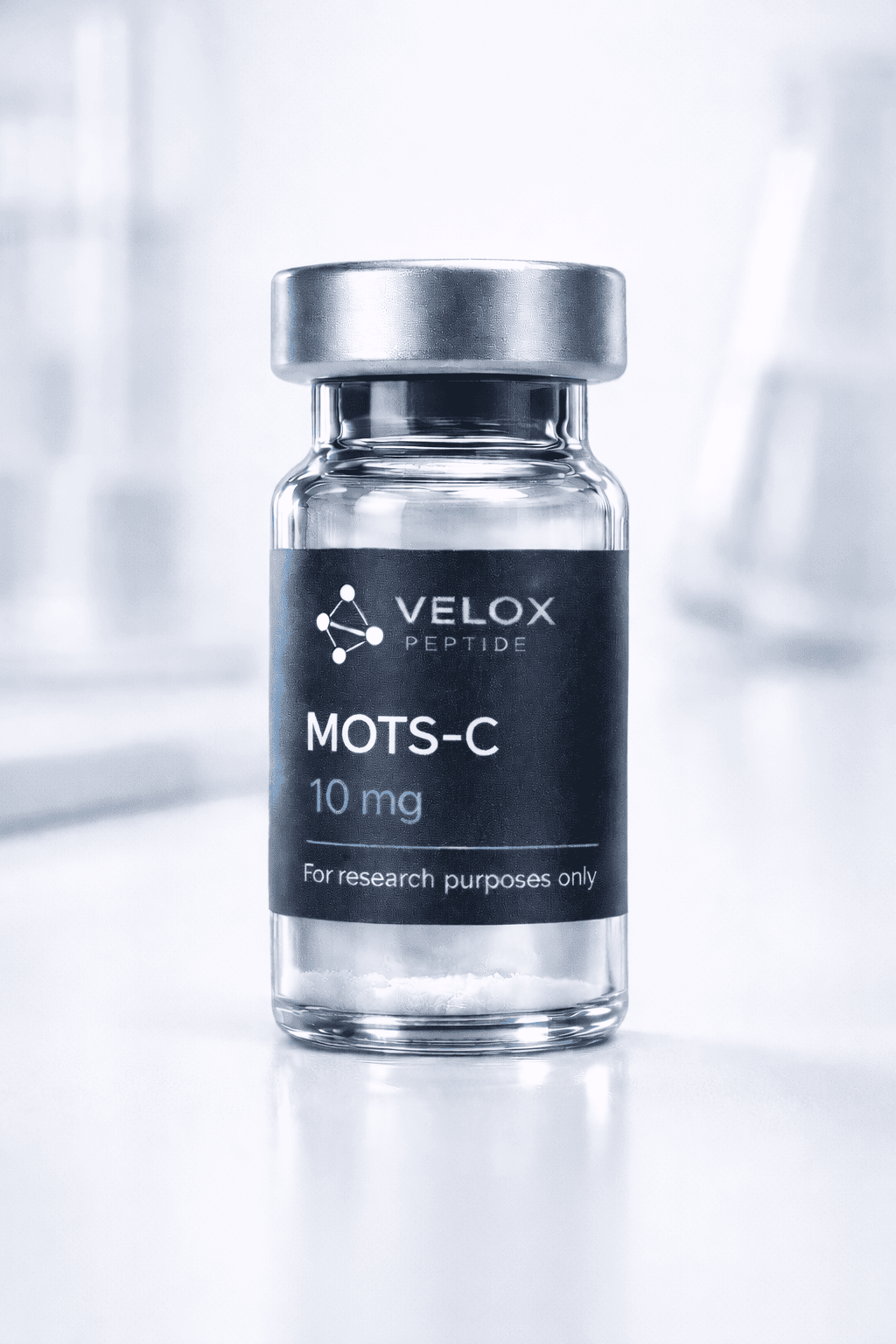
Composto di ricerca · Solo per uso scientifico
MOTS-c — Mitochondrial-Encoded Longevity Peptide
16-amino acid mitochondria-derived peptide · AMPK agonist · lyophilised · ≥99% HPLC purity
- ≥99% purity, HPLC-verified with certificate of analysis
- Mitochondria-derived — not nuclear-encoded
- EU-manufactured, shipped EU-wide
- For in vitro and preclinical research only
Cold Exposure, BAT Thermogenesis, and the Broader Picture
The exercise mimetic study is compelling, but it doesn't exist in isolation. Earlier MOTS-c research showed effects on cold-induced brown adipose tissue (BAT) thermogenesis — another metabolic stress response that shares mechanistic overlap with exercise physiology. In those studies, MOTS-c-treated mice maintained core temperature better under cold exposure and showed elevated uncoupling protein 1 (UCP1) expression in brown adipose tissue.
UCP1 drives thermogenesis by uncoupling mitochondrial electron transport from ATP synthesis — burning fuel as heat rather than storing it. The fact that MOTS-c appears to influence this system suggests its exercise-mimetic properties may be part of a broader mitochondrial stress-response role, rather than a narrow skeletal muscle-specific effect.
For researchers exploring the intersection of longevity and metabolic biology, the Longevity Blend — combining Epitalon and MOTS-c — offers a research tool that pairs MOTS-c's mitochondrial and AMPK signalling effects with Epitalon's proposed telomerase-activating properties, for researchers studying multiple aspects of cellular ageing simultaneously.
Research Implication: Age-Related MOTS-c Decline
Endogenous circulating MOTS-c levels decline with age in humans — this has been documented in both cross-sectional studies comparing younger versus older individuals and in longitudinal data. This decline correlates with age-associated reductions in exercise capacity and metabolic flexibility. Whether exogenous MOTS-c administration can restore youthful metabolic parameters in aged animals (and eventually humans) is one of the central research questions in the mitochondrial peptide field, and the one that motivates most of the current longevity-focused MOTS-c research programmes.
Where the Research Needs to Go
The current MOTS-c research base is built almost entirely on mouse models. That's appropriate for a compound at this stage of investigation, but it means there are substantial gaps. The bioavailability and pharmacokinetics of injected MOTS-c in larger mammals, the dose-response relationship in primates, the effects in aged versus young animals, and the durability of metabolic effects after cessation of administration are all open questions.
The mitochondrial origin of MOTS-c also raises interesting immunological questions. Mitochondria are evolutionarily derived from ancient bacteria, and mitochondria-derived peptides have been shown in some contexts to trigger innate immune responses. Whether MOTS-c has immunomodulatory properties beyond its metabolic effects, and whether repeated exogenous administration triggers any adaptive immune response, aren't fully characterised.
The exercise mimetic concept is compelling and the mechanistic story is coherent. But the field is at the stage where the data is promising rather than conclusive — which is precisely where preclinical research tools are most valuable.
Open Research Question: Dose-Duration Optimisation
The 5 mg/kg three-times-weekly dosing used in the mouse study represents one point in a large dose-duration space that hasn't been systematically explored. Lower continuous dosing, higher intermittent dosing, and depot formulations would all produce different pharmacokinetic profiles and potentially different biological effects. Dose-response characterisation across multiple metabolic endpoints is among the most practically useful research that the field currently needs.

Composto di ricerca · Solo per uso scientifico
Longevity Blend — Epitalon + MOTS-c Research Combination
Epitalon tetrapeptide + MOTS-c mitochondrial peptide · Combined lyophilised formulation · ≥99% HPLC
Research use only. MOTS-c is not approved for human therapeutic use. VeloxPeptide supplies research-grade peptides for in vitro and preclinical laboratory research exclusively, with ≥99% HPLC purity certification.