
A Compound in an Uncomfortable Middle Position
In the longevity research world, few compounds have generated as much ongoing debate as Epitalon. It sits in an uncomfortable middle position: more research behind it than almost any other peptide bioregulator, most of that research coming from a single institution with a specific research tradition, and a proposed mechanism — telomerase activation — that is simultaneously one of the most compelling ideas in ageing biology and one of the most contested therapeutic targets.
Three decades of data from the Khavinson Institute is a lot to dismiss. It's also a lot to accept without independent replication. Where the evidence actually sits, and what researchers working with Epitalon today should take seriously, requires looking carefully at both sides of that equation.
The Telomere Biology Context
Telomere biology has been one of the most compelling areas in ageing research since Elizabeth Blackburn, Carol Greider, and Jack Szostak received the 2009 Nobel Prize for work on telomeres and telomerase. The basic story is well established: human somatic cells have a finite number of divisions before telomere shortening triggers senescence or apoptosis (this is the Hayflick limit). Telomerase — specifically its catalytic subunit, hTERT — can counteract this by adding TTAGGG repeat sequences to telomere ends, effectively resetting the molecular clock.
In germ cells, stem cells, and certain tissue progenitors, telomerase is naturally active. In most adult somatic cells, hTERT expression is suppressed. This suppression is one of the factors that limits tissue regenerative capacity with age. Re-activating hTERT in somatic cells is therefore a plausible anti-ageing strategy — and Epitalon's proposed mechanism is exactly that.
In Vitro Telomerase Data
Cell culture studies using the TRAP (Telomeric Repeat Amplification Protocol) assay show elevated telomerase activity in Epitalon-treated human fibroblast and lymphocyte cultures. Effect sizes are larger in the Khavinson group's published data than in independent replications.
Drosophila Lifespan Studies
Melanogaster model studies report 11–16% median lifespan extension with Epitalon treatment, published across multiple Khavinson-affiliated papers from the 2000s–2010s. Independent Drosophila replication has not been published.
Rodent Cancer/Tumour Data
Cancer-prone rat and mouse strains treated with Epitalon show reduced tumour incidence and marginally increased mean lifespan in several Khavinson Institute studies. This finding is particularly important because it bears on the cancer risk question.
Human Observational Data
A 25-year follow-up study in elderly St. Petersburg patients reported ~28% lower all-cause mortality in a peptide bioregulator treatment group vs. non-treated controls. Significant confounds exist: non-randomised, multiple concurrent peptide treatments, no placebo control.
The Evidence Hierarchy: What It Shows and Doesn't
The cleanest way to assess Epitalon's evidence base is to ask, for each type of claim, how strong the supporting data actually is and how independently it has been verified.
Epitalon Evidence Assessment by Claim Type
| Claim | Khavinson Data | Independent Replication | Assessment |
|---|---|---|---|
| Telomerase activation (in vitro) | Multiple papers, TRAP assay | Partial — some groups confirm direction | Plausible, not confirmed |
| hTERT upregulation | Published mRNA/protein data | Limited independent data | Preliminary |
| Drosophila lifespan | 11–16% median extension | Not independently replicated | Interesting, unconfirmed |
| Reduced tumour incidence (rodent) | Several cancer-prone strain studies | Not independently replicated | Important if confirmed |
| Human longevity | 25-yr observational study | No RCT data | Signal only — not evidence of efficacy |
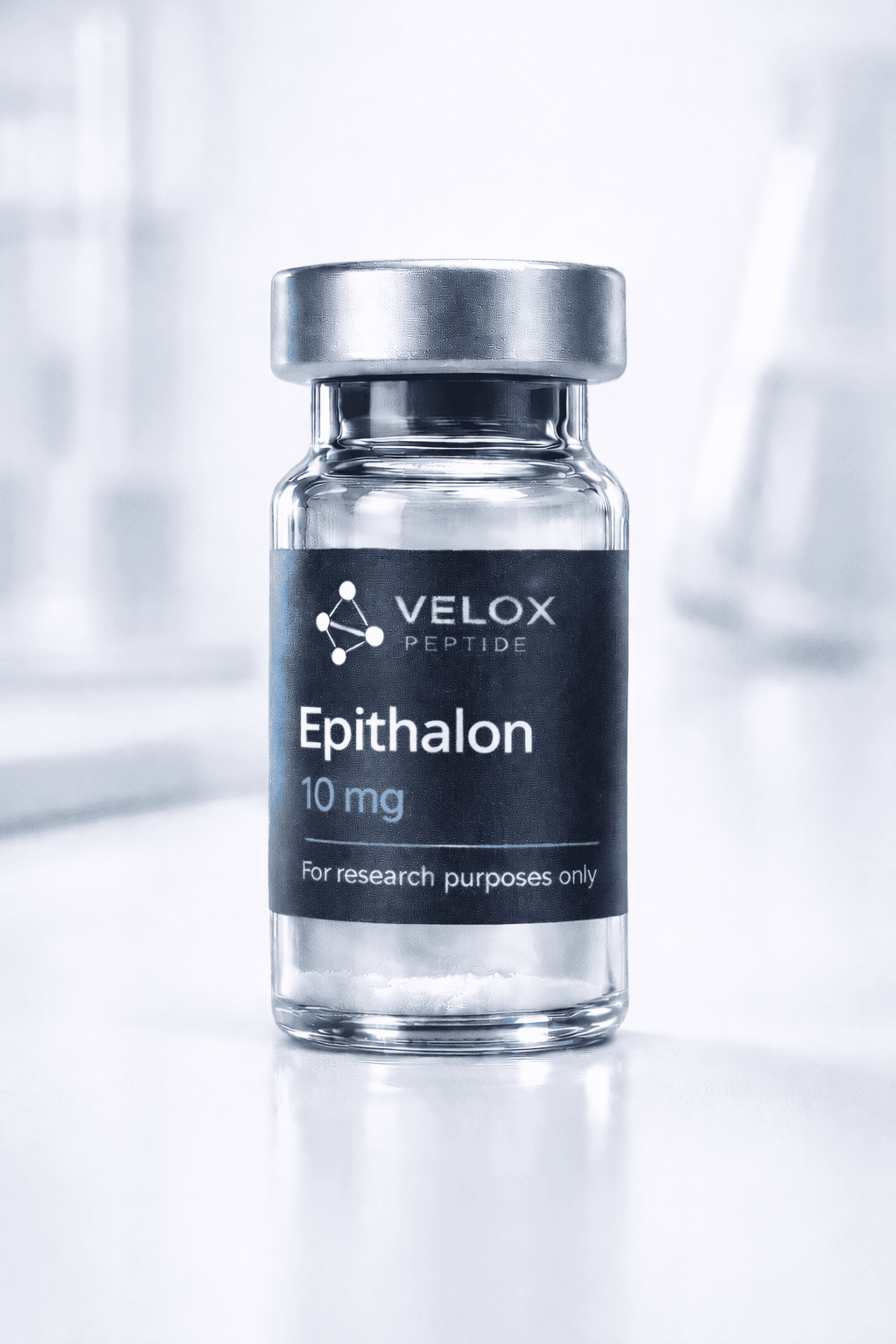
Forschungsverbindung · Nur für wissenschaftliche Zwecke
Epitalon (Ala-Glu-Asp-Gly) — Telomere Biology Research Peptide
Synthetic tetrapeptide · Sequence: Ala-Glu-Asp-Gly · MW 390.35 Da · lyophilised · ≥99% HPLC purity
- ≥99% purity, HPLC-verified with mass spectrometry confirmation
- Chemically synthesised tetrapeptide — minimal impurities
- EU-manufactured, shipped EU-wide
- For in vitro and preclinical research only
The Cancer Risk Question That Doesn't Go Away
Telomerase is activated in approximately 90% of human cancers. This is what allows cancer cells to maintain their telomeres and divide indefinitely — they've essentially solved the Hayflick limit problem in the worst possible way. Pharmacological activation of telomerase in normal cells creates a theoretical concern: you might be pushing normal cells toward the same unlimited replication capacity that makes cancer cells dangerous.
The Khavinson group has addressed this directly, arguing that their animal data actually shows reduced tumour incidence in Epitalon-treated groups, not increased. Their interpretation is that Epitalon doesn't cause rampant telomerase activation but rather restores physiologically normal telomerase function in cells where it has declined below healthy baseline — a subtle but important distinction. If that's correct, Epitalon might restore a protective level of telomere maintenance without pushing cells into the unchecked replication mode characteristic of cancer.
That would be a reassuring finding if independently confirmed. It hasn't been — which is why mainstream oncology and telomere biology researchers haven't embraced telomerase activation as an anti-ageing therapeutic target. The cancer risk concern remains the most significant theoretical barrier to clinical development of telomerase-activating compounds.
The Central Unresolved Question
Does pharmacological telomerase activation at sub-maximal levels (restoring physiological function rather than driving unlimited replication) carry a different cancer risk profile than the constitutive telomerase activation seen in tumour cells? The Khavinson data suggests not — or even suggests a protective effect. Independent confirmation of the reduced tumour incidence finding in cancer-prone rodent strains would significantly advance the field's understanding of this question.
What Independent Replication Has Found
Some Western and independent research groups have attempted partial replication of Epitalon's claimed properties. The picture is mixed but not purely negative. In cell culture TRAP assays — the most straightforward test of telomerase activity — some independent groups have confirmed elevated telomerase readings in Epitalon-treated cultures, though typically with smaller effect sizes than the Khavinson data. A minority of attempts have found no significant effect.
The variability in independent results could reflect genuine effect variability (dose, cell type, passage number all matter in telomerase assays), methodological differences in TRAP assay protocols, or the possibility that the Khavinson group's consistently larger effect sizes reflect publication bias or result selection. Without pre-registered replication studies, it's difficult to know which explanation is most accurate.
A growing number of Western research groups have initiated their own in vitro characterisation work with Epitalon as a research peptide. The compound is simple enough (a tetrapeptide of four amino acids) that high-purity synthesis is straightforward, and the TRAP assay is a standard enough technique that many cell biology labs can run it without specialised equipment. Independent replication at scale is technically feasible — the bottleneck is interest and funding.
Research Consideration: TRAP Assay Sensitivity
Telomeric Repeat Amplification Protocol (TRAP) assays are sensitive but require careful controls for PCR inhibition. Peptides at higher concentrations can occasionally interfere with PCR efficiency, producing artefactual results. Independent replication studies should include RNase controls (to confirm telomerase-dependent signal), heat-inactivation controls (to distinguish enzymatic from non-enzymatic effects), and multiple Epitalon concentrations to establish a dose-response curve rather than single-point measurements.
The Broader Peptide Bioregulator Research Tradition
Epitalon is part of a larger research tradition developed primarily by Khavinson and his colleagues: synthetic peptide bioregulators, each typically 2–4 amino acids, designed to target specific tissues and regulatory systems. Epithalamin (the pineal gland extract from which Epitalon was derived) was among the first. Others include Vilon (Lys-Glu, immune system), Thymalin (thymus extract), and Pinealon (Glu-Asp-Arg, neural tissue).
The broader bioregulator research tradition is interesting precisely because it asks whether small peptides can serve as tissue-specific regulatory signals — essentially, whether there are short peptide "keys" that unlock specific gene expression programmes in specific tissues. That's a genuinely interesting hypothesis that isn't well captured by Western pharmacology's traditional small-molecule paradigm, and it's one that deserves more rigorous investigation than it has received outside the Khavinson group.
For researchers studying longevity biology across multiple pathways simultaneously, the Longevity Blend (Epitalon + MOTS-c) allows investigation of both telomere biology (Epitalon) and mitochondrial-metabolic pathways (MOTS-c) in the same experimental system.
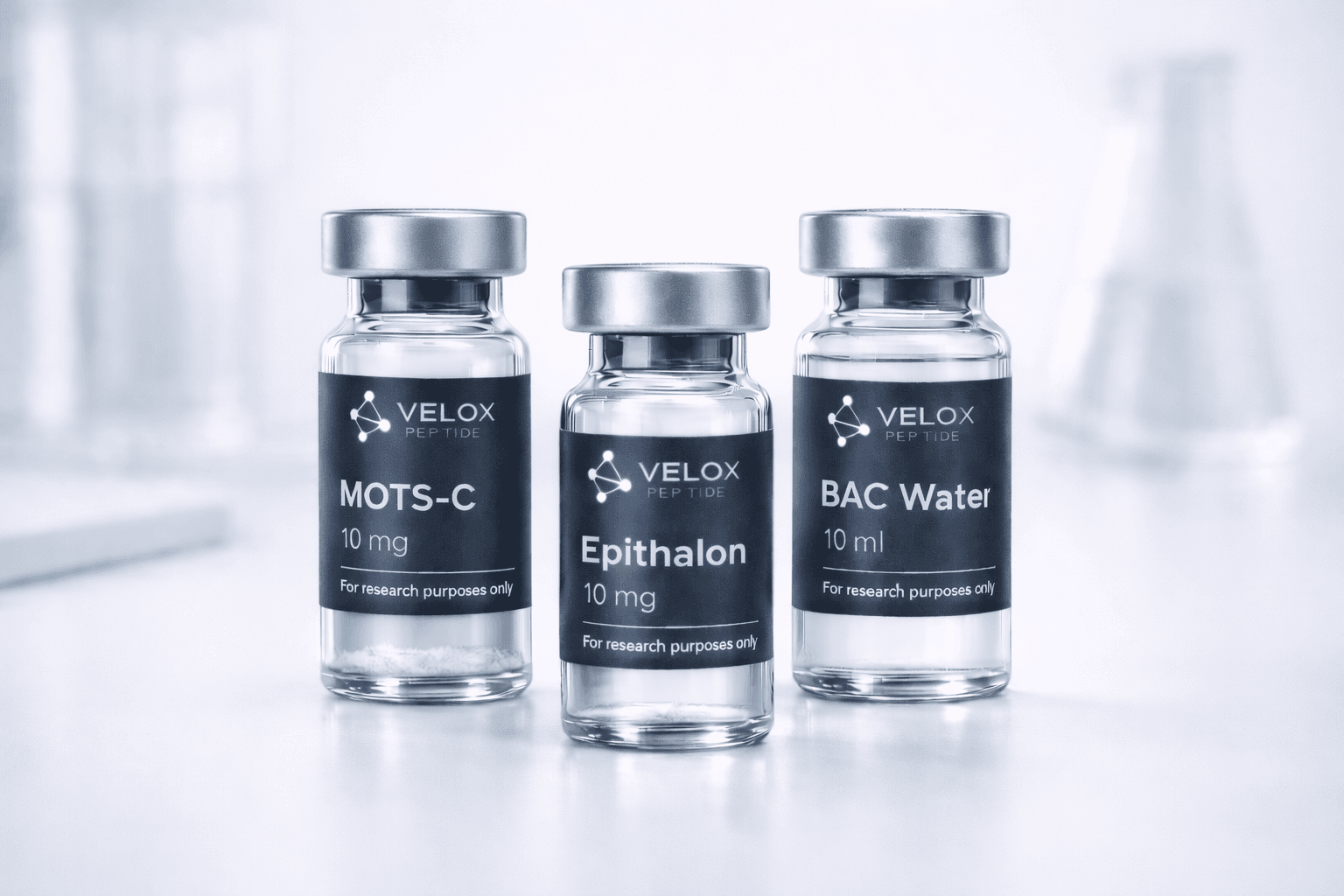
Forschungsverbindung · Nur für wissenschaftliche Zwecke
Longevity Blend — Epitalon + MOTS-c Research Combination
Epitalon tetrapeptide + MOTS-c mitochondrial peptide · Combined lyophilised · ≥99% HPLC
Research use only. Epitalon is not approved for human therapeutic use. VeloxPeptide supplies research-grade peptides for in vitro and preclinical laboratory research. All compounds are sold with certificates of analysis confirming ≥99% HPLC purity.